How to Calculate Volume: The Complete Guide for Every Shape
Master volume calculation with our comprehensive guide. Learn cross-section formulas for 14 shapes, unit conversions, and worked examples.
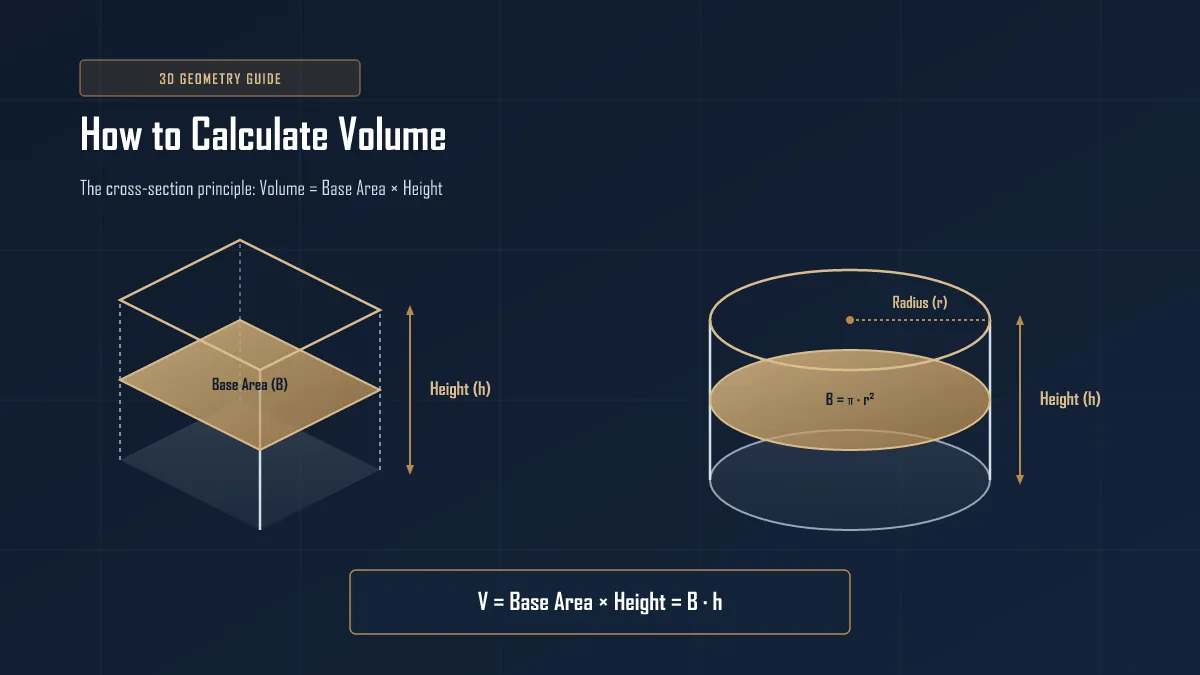
Volume is one of the most fundamental measurements in daily life, construction, and physical science. Whether you are ordering ready-mix concrete for a backyard patio slab, estimating the gallons needed to fill an above-ground swimming pool, calculating packing carton capacity for freight shipping, or determining how many bags of potting soil your garden planter requires, understanding volume allows you to plan accurately and avoid costly material waste.
This guide provides a comprehensive overview of 3D volume mathematics written specifically for practical US applications. We will explore the geometric intuition behind volume, examine the universal cross-section principle, provide a reference formula table for 14 common geometric shapes, explain essential US customary unit conversions, walk through two complete real-world examples, and review the four most common mistakes to avoid.
1. What Is Volume?
In physics and mathematics, volume represents the total amount of three-dimensional space occupied by a solid object, liquid, or gas.
To build intuitive understanding, consider the progression from one dimension to three dimensions:
- One Dimension (Length): A linear distance measured along a single axis (such as inches, feet, or yards). A piece of string or tape measure spans one dimension.
- Two Dimensions (Area): A flat surface measured in square units (such as square feet, ft², or square inches, in²). A tabletop or floor plan covers two dimensions (length × width).
- Three Dimensions (Volume): A hollow or solid container that encloses physical space, measured in cubic units (such as cubic feet, ft³, or cubic yards, yd³) or liquid capacity units (such as US gallons, quarts, and liters).
A cubic foot (ft³) represents a cube measuring exactly one foot long, one foot wide, and one foot deep. When we calculate volume, we are simply finding how many of those unit cubes can fit inside a given boundary.
2. The Cross-Section Principle (Cavalieri’s Principle)
Most geometric formulas can seem intimidating when memorized in isolation, but nearly all of them originate from a single, elegant geometric concept: the uniform cross-section principle (formulated by mathematician Bonaventura Cavalieri in the 17th century).
Uniform Cross-Sections (Prisms and Cylinders)
Imagine a standard loaf of sandwich bread. Each individual slice has an identical shape and surface area. If you know the two-dimensional area of one slice (the base area, B) and you know the total length of the loaf (the height or length, h), the total volume is simply:
Volume = Base Area × Height = B · h
This universal rule applies to every prism and cylinder, regardless of the base shape:
- For a rectangular box, the base is a rectangle (B = l · w), giving V = l · w · h.
- For a cylinder, the base is a circle (B = π · r²), giving V = π · r² · h.
- For a triangular prism, the base is a triangle (B = ½ · b · h_base), giving V = ½ · b · h_base · L.
Tapering Cross-Sections (Pyramids and Cones)
When a three-dimensional shape does not remain uniform but instead tapers smoothly to a single apex point—such as a pyramid or a cone—the cross-sectional area decreases quadratically from the base to the tip.
Through calculus (or Archimedes’ classic displacement method), it is proven that any cone or pyramid holds exactly one-third of the volume of an equivalent prism or cylinder sharing the same base and height:
Volume = ⅓ × Base Area × Height = ⅓ · B · h
- For a circular cone: V = ⅓ · π · r² · h.
- For a square or rectangular pyramid: V = ⅓ · l · w · h.
Curved Symmetrical Shapes (Spheres and Ellipsoids)
For shapes with continuously changing curvature, such as spheres, the volume is derived by integrating thin circular discs from the south pole to the north pole:
Volume = ⁴⁄₃ · π · r³
Notice that a sphere’s volume is exactly two-thirds the volume of a cylinder that tightly encloses it (V_cylinder = π · r² · 2r = 2π · r³).
3. Master Volume Formulas for 14 Shapes
The table below outlines the standard geometric formulas for 14 primary three-dimensional forms. Use this reference whenever you encounter a specific physical container or architectural structure.
| Shape | Formula | Variables & Definitions |
|---|---|---|
| Cube | V = s³ | s = edge side length |
| Rectangular Prism | V = l · w · h | l = length, w = width, h = height |
| Cylinder | V = π · r² · h | r = radius, h = height (π ≈ 3.14159) |
| Sphere | V = ⁴⁄₃ · π · r³ | r = radius |
| Cone | V = ⅓ · π · r² · h | r = base radius, h = vertical height |
| Pyramid | V = ⅓ · l · w · h | l = base length, w = base width, h = vertical height |
| Hemisphere | V = ⅔ · π · r³ | r = radius (half of a full sphere) |
| Triangular Prism | V = ½ · b · h_t · L | b = triangle base, h_t = triangle height, L = prism length |
| Prism (General) | V = B · L | B = known base area, L = prism length |
| Triangular Pyramid | V = ⅙ · b · h_b · h | b = base edge, h_b = base altitude, h = pyramid height |
| Trapezoidal Prism | V = [(a + b) / 2] · h_t · L | a, b = parallel sides, h_t = trapezoid height, L = length |
| Ellipsoid | V = ⁴⁄₃ · π · a · b · c | a, b, c = three semi-axis lengths (semi-width, height, depth) |
| Hollow Cylinder | V = π · (R² - r²) · h | R = outer radius, r = inner radius, h = height |
| Truncated Cone | V = ⅓ · π · h · (R² + R·r + r²) | R = bottom radius, r = top radius, h = vertical height |
4. Navigating US Volume Units and Conversions
In the United States, measurements frequently shift between linear feet and inches, cubic feet, cubic yards, and liquid gallons. Understanding how these units interrelate avoids significant ordering errors.
The Critical Cubic Feet to US Gallons Factor
One of the most practical conversions for homeowners, pool owners, and plumbers is converting cubic feet to US liquid gallons:
1 cubic foot (ft³) ≈ 7.48052 US gallons
If you calculate the cubic footage of a water container, simply multiply the cubic feet by 7.48 to determine liquid gallon capacity. Conversely, if you know a tank holds 1,000 gallons, divide by 7.48052 to find that you need approximately 133.68 ft³ of storage space.
The Definition of a US Gallon in Cubic Inches
Under statutory US NIST standards:
1 US liquid gallon ≡ 231 cubic inches (in³)
Because 1 foot = 12 inches, one cubic foot contains 12 × 12 × 12 = 1,728 cubic inches. Dividing 1,728 by 231 yields exactly 7.48051948… gallons.
Cubic Yards for Landscaping and Concrete
For bulk landscaping materials (topsoil, gravel, crushed stone, mulch) and ready-mix concrete, suppliers price and deliver orders by the cubic yard (yd³):
1 cubic yard = 3 ft × 3 ft × 3 ft = 27 cubic feet
When calculating concrete slabs or garden beds, find the total cubic feet and divide by 27 to determine how many cubic yards to order.
5. Detailed Worked Examples
Let’s walk step-by-step through two everyday scenarios using standard US measurements.
Example 1: Calculating Room Air Volume in Feet
Scenario: You need to size a HEPA air purifier or portable air conditioner for a master bedroom. The room measures 14 feet long by 12 feet wide, with 9-foot ceilings.
- Step 1: Identify the shape. A standard residential room is a rectangular prism.
- Step 2: Collect dimensions in uniform units. All dimensions are already in feet: l = 14 ft, w = 12 ft, h = 9 ft.
- Step 3: Apply the formula. V = l · w · h V = 14 ft × 12 ft × 9 ft = 1,512 ft³
- Step 4: Convert to liquid capacity (optional). If you wanted to understand this room in terms of liquid volume: 1,512 ft³ × 7.48052 gal/ft³ ≈ 11,310.5 US gallons The bedroom contains 1,512 cubic feet of air.
Example 2: Determining Potting Soil for a Round Patio Planter
Scenario: You purchased a tapered round planter for your patio. The top rim has an interior diameter of 18 inches, and the planter has an interior planting depth of 24 inches. (Assuming straight vertical cylindrical walls for a standard pot approximation).
- Step 1: Identify the shape and convert diameter to radius. The planter is a vertical cylinder. The diameter is 18 inches. The radius is half the diameter: r = 18 / 2 = 9 inches The height is h = 24 inches.
- Step 2: Calculate volume in cubic inches. V = π · r² · h V = π × (9 in)² × 24 in = π × 81 × 24 ≈ 6,107.26 in³
- Step 3: Convert cubic inches to cubic feet. Since 1 ft³ = 1,728 in³: Volume in ft³ = 6,107.26 / 1,728 ≈ 3.534 ft³
- Step 4: Convert to soil bag quantities. Most garden centers sell premium potting soil in 1.5 cubic foot bags. 3.534 ft³ / (1.5 ft³/bag) ≈ 2.36 bags You should purchase 3 bags of potting soil to comfortably fill the container.
6. Four Common Volume Mistakes to Avoid
Even experienced builders and planners occasionally make mistakes when calculating capacity. Here are the four most frequent errors:
- Mixing Measurement Units: The single most common error is multiplying dimensions in different units—such as multiplying a 10-foot room length by an 8-inch concrete slab depth (10 × 8 = 80, which is completely incorrect). Always convert inches to decimal feet (8 in ÷ 12 = 0.667 ft) before calculating.
- Using Diameter Instead of Radius: In formulas featuring r² or r³ (such as cylinders, spheres, and cones), using the full diameter instead of radius squares the error. Using diameter instead of radius results in an answer that is four times too large for cylinders and eight times too large for spheres.
- Confusing US and Imperial Gallons: The British Imperial gallon (4.54609 liters) is approximately 20% larger than the US liquid gallon (3.78541 liters). When buying imported equipment, pumps, or aquariums, ensure your calculation uses the correct gallon standard.
- Ignoring Wall Thickness: When calculating the interior storage volume of boxes, tubs, or pipe walls, external dimensions will overstate the true capacity. Always measure or calculate using the internal dimensions (R - thickness).